Deepan Roy
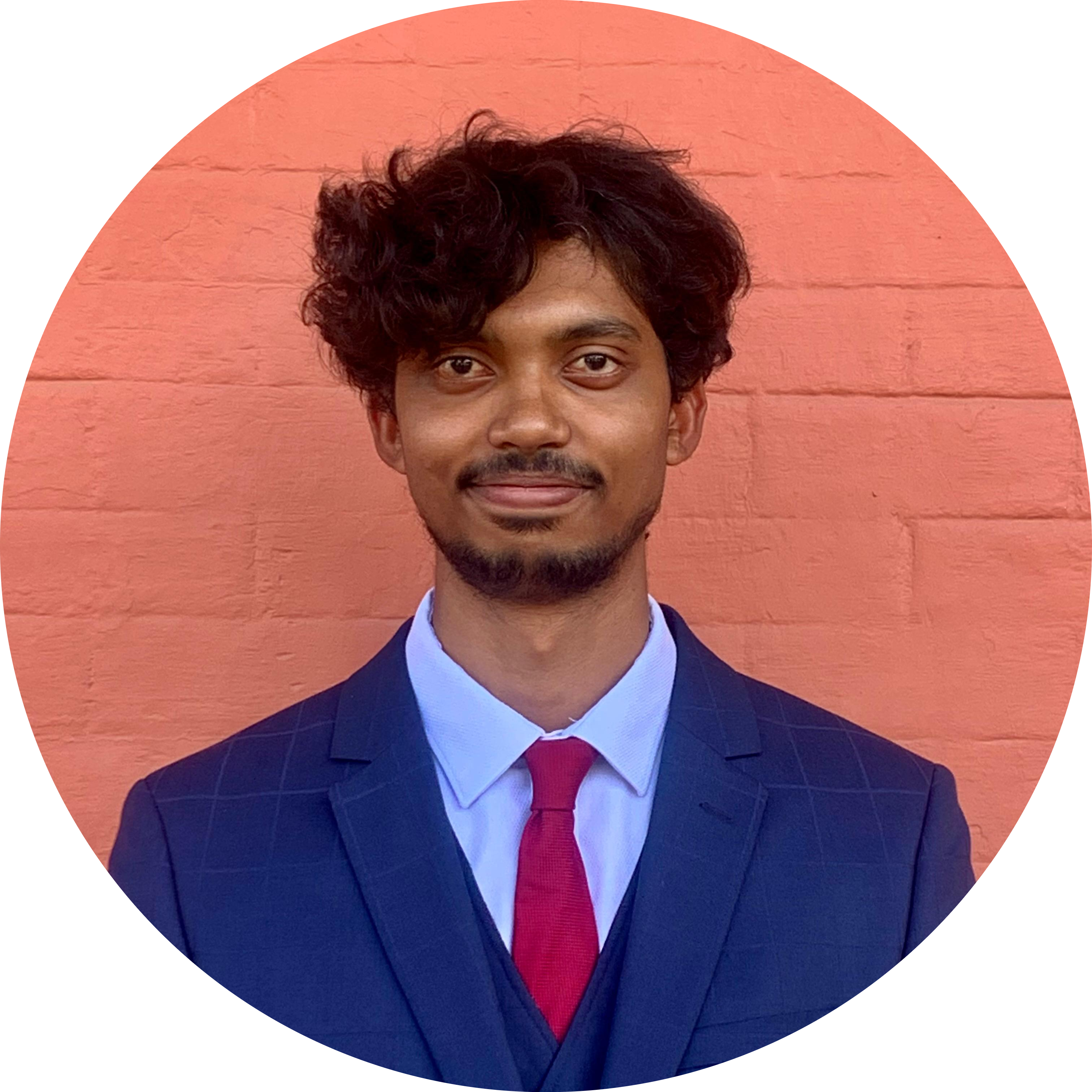
Hi! I’m an aspiring researcher focused on computer vision, with research experience in computational photography and crime detection,
project experience in 3D biomedical imagery, and work experience at Stripe.
I'm skilled in 2D/3D computer vision, federated learning, and generative image modeling through hands-on research and implementations.
Email / LinkedIn / Resume
Portfolio
Education
- B.E., Computer Science: Birla Institute of Technology and Science, Pilani
- Relevant Coursework: Generative AI, Introduction to LLMs, Natural Language Processing, Deep Learning, Linear Algebra, Probability & Statistics
Experience
-
3D Tubular Instance Segmentation in Biomedical Imaging (Sept. 2025 – Present)
Working with Dr. Donglai Wei on global reasoning on 3D biomedical images, specifically on thin, elongated structures which require global pairwise point affinity learning to reason over ambiguous structures.
-
mmWave Radar to Speech Enhancement (Oct. 2025 – Present)
Working with Prof. Sandeep Joshi to enhance speech from extremely noisy, band-limited mmWave FMCW radar signals using diffusion- and GAN-based methods, like CDiffuSE and CleanMel+Vocos, respectively.
-
Software Engineering Intern @ Stripe (May 2025 - Jul. 2025)
Saved $200K per annum by reducing 700K manual verifications for merchant addresses using LLMs. Conducted prompt engineering experiments with 1,000 user addresses to reduce the LLM’s false rejection rate to <2%. Also created an abstract framework to reduce time to create new LLM verification systems from ∼2 weeks to ∼1 day.
-
Computational Photography using Federated Learning (Aug. 2024 – May 2025)
Research under Prof. Pratik Narang related to augmenting computational photography tasks, specifically denoising, with federated learning techniques to solve the problem of limited noisy-clean image pair data. Worked on training and evaluating established approaches like DnCNN, DBSN, and Blind2Unblind on custom noise models in federated setups.
-
Crime Detection in Surveillance Videos (Nov. 2023 – May 2024)
Worked on the task of detecting and classifying 10 crime types in the UCF-Crime dataset using YOLOv3 and DeepSORT. Preprocessed 1000+ videos, then designed, trained, and tuned an LSTM model, achieving an AUC score of 62.5%, approaching state-of-the-art performance.
Projects
-
3D Semantic Segmentation of EPFL Electron Microscopy Dataset
Solved 3D segmentation task on the EPFL Electron Microscopy Dataset using Morphological Post-Processing, nnU-Net, and Foundation Models. Produced a strong baseline Dice score of 94.05% with nnU-Net, then experimented with MIS-FM. Pre-trained PCT-Net using Volume Fusion on the unannotated volume, achieving Dice of 99.93% on the pretext task. Analysed and experimented with preprocessing, Focal Dice, schedulers, and postprocessing to tune downstream training, increasing the Dice score from 42% to 93%.
-
Implementation of Conditional PixelVAE, PixelCNN for Handwritten Digit Generation
Implemented the PixelCNN, conditional PixelCNN, and PixelVAE architectures. Extended the PixelVAE architecture by creating a conditional PixelVAE, which achieved strong quantitative performance on binarised MNIST dataset with an average NLL of 0.169 nats per pixel.
-
From-Scratch Neural Learning in NumPy via Adam Optimisation
Built forward/backward passes with analytical gradients and gradient descent to study neural learning without frameworks. Re-constructed the Adam optimiser from scratch, yielding 100% test accuracy. Also visualised the model’s predictions via decision boundaries.